Dr. Lindsey Cormack Talks to the Ridgewood Community about Civics
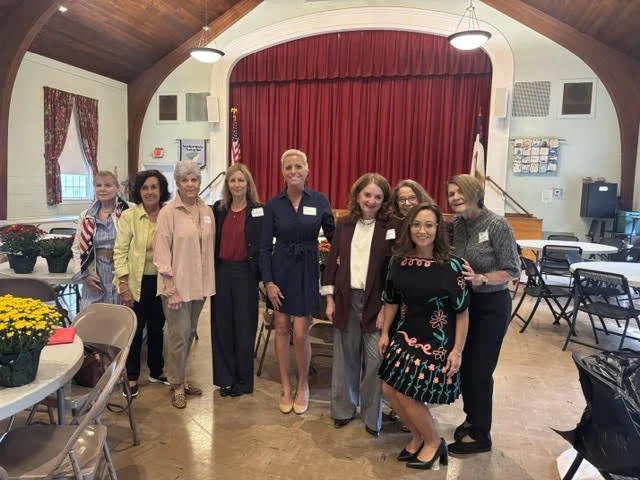
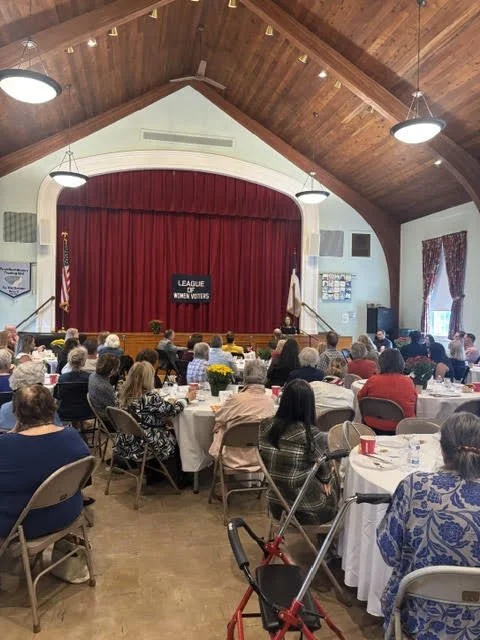
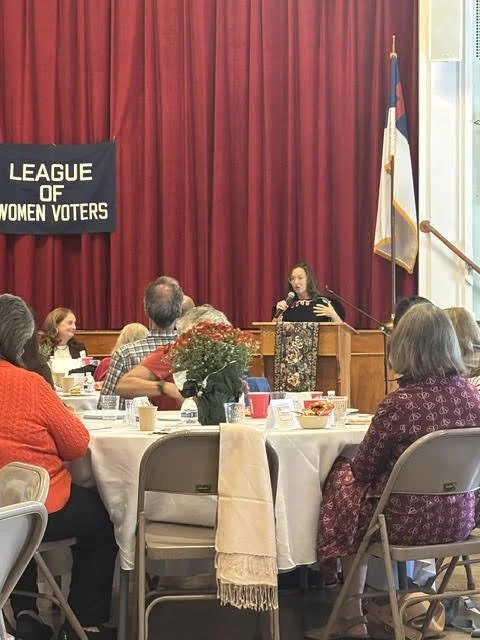
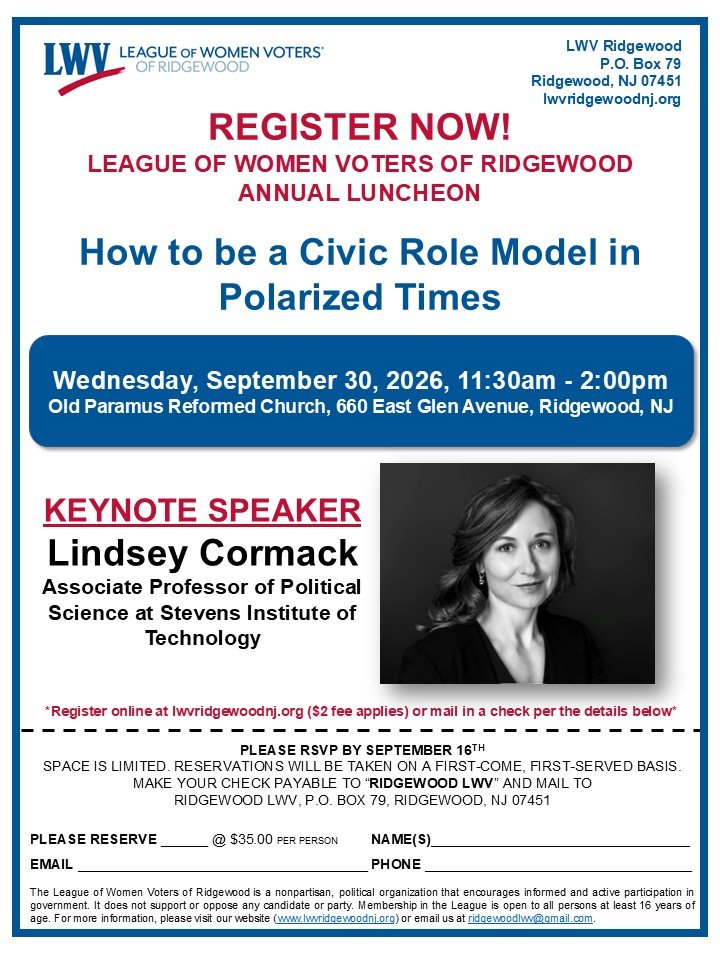
The League of Women Voters of Ridgewood hosted a sold-out luncheon last Wednesday, September 30, at the Old Paramus Reformed Church, featuring speaker Lindsey Cormack, a professor of political science at Stevens Institute of Technology and the author of several books and host of the podcast "Government That Doesn't Suck." The title of her talk was "How to Be a Civic Role Model in Polarized Times." LWV Director Laura McKenna, who has a Ph.D. in political science and has been on the faculty at Ramapo College, Columbia, and Hunter College, introduced Prof. Cormack as well as helped coordinate the event. In attendance were Senator Holly Schepisi (Dist. 39), Ridgewood Public Schools Superintendent Mark Schwarz, Mayor of Ridgewood Paul Vagianos, Deputy Mayor Pamela Perron, Ridgewood Village Manager Keith Kazmark and Councilpersons Siobhan Winograd and Evan Weitz, Ridgewood Board of Education President Sheila Brogan and Board Trustee Mary Micale, and Bergen County Commissioner Mary Amoruso, among other community leaders.
Dr. Cormack charmed and engaged the audience, starting with the scene in which the founders of the United States worked: average lifespan was 38 years; there was no safe drinking water, so adults and children alike drank alcohol; people used outhouses, and most people worked in agriculture, though many founders themselves were engineers. Despite the challenges they faced, they hammered out the Constitution, which - despite the moral failings of our nation like slavery - established a country of citizens, not subjects, that endures today. According to Dr. Cormack, the U.S. is a place where people largely want to live, immigrate to, and stay (98% of people born in the United States or who immigrate to the U.S. stay for the rest of their lives). On the other hand, some 70% of the world's population lives under autocratic rule.
Dr. Cormack's prescription for how to be a civic role model included the following:
1) advocate for more civics education in K-12. Even high-achieving students at competitive colleges like Stevens are undereducated in civics, as are most students, including the few who self-select into AP Government courses. Those courses now employ grade inflation in order to enable students to achieve a "3" or above (thus having the unfortunate effect of exempting those students from a 101 government or political science course in college, compounding the problem);
2) speak positively of our elected officials and don't generalize about elected officials based on the misdeeds or incompetence of the few (as much of our popular culture does, including programs for kids like Paw Patrol). More children should aspire to be leaders in all levels of government;
3) volunteer to serve on a community board or other committee of your local government or run for office. Government is not something that happens to you but rather something that you as an American citizen are able to join and work to improve. Dr. Cormack emphasized that this work has never been easy and that working toward a "more perfect" union is ongoing hard work but worthwhile: for example, the Articles of Confederation didn't survive, but much of the work made its way into the Constitution. Dr. Cormack herself serves on a community board in Manhattan (and is a member of the League of Women Voters).
Dr. Cormack fielded hard-hitting questions, including several from RHS history teacher Freddie LaFemina, who asked what the right response is to those who use democratic means to achieve anti-democratic ends. Dr. Cormack received a standing ovation.